EPC
August-Wilhelm Scheer’s notation based on alternating events and functions linked by logical connectors. The de facto standard for SAP projects and the ARIS platform.
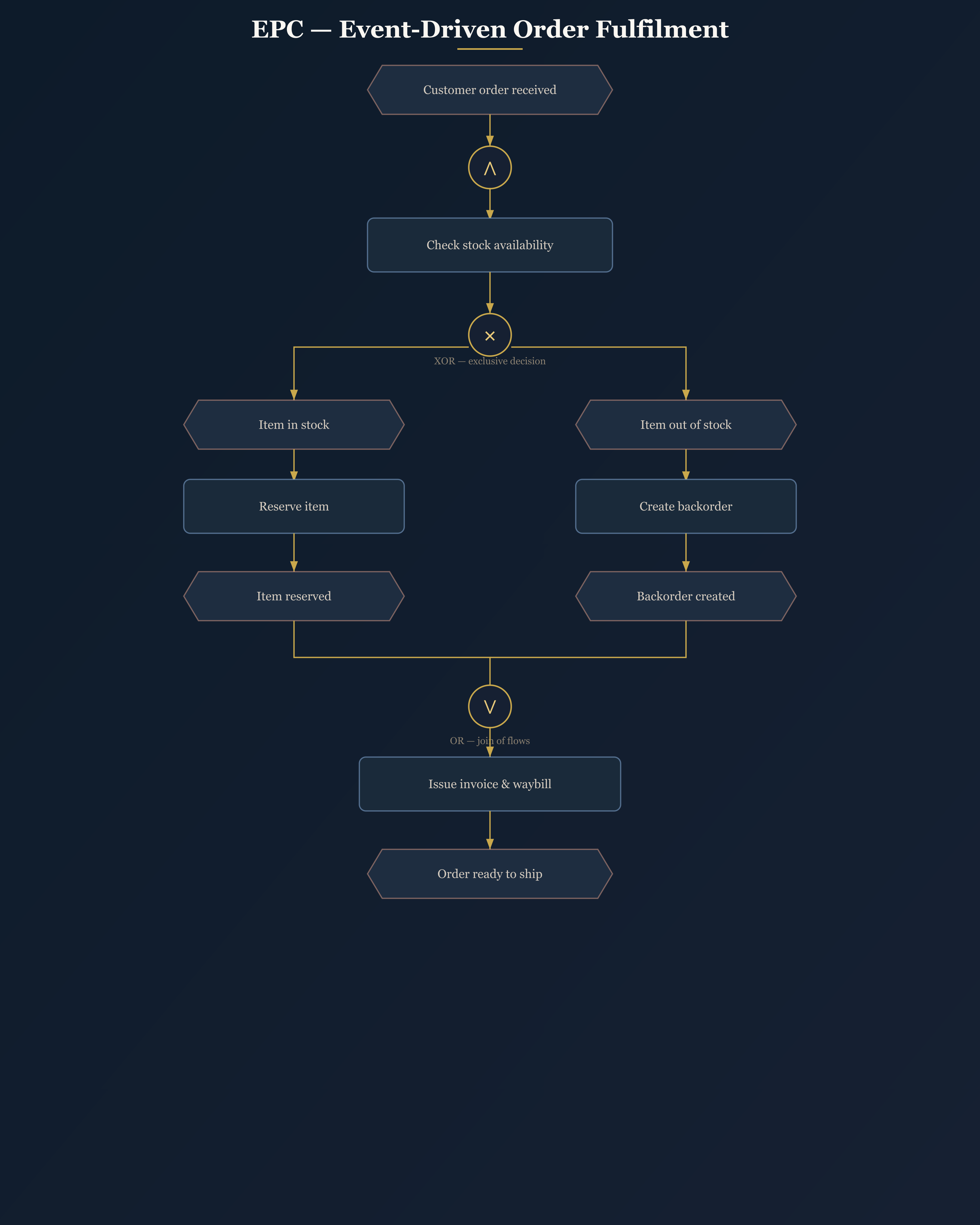
↓ Download reference poster (PDF, A2)
How it came about
The Event-driven Process Chain (EPC) was developed in the early 1990s by Professor August-Wilhelm Scheer together with SAP AG, within the ARIS (Architecture of Integrated Information Systems) framework. The notation quickly became the de facto standard for SAP R/3 implementation projects, and by 2000 the ARIS platform counted more than 8,000 enterprise customers worldwide.
Basic principles
EPC is built on the alternation of two kinds of nodes:
- Events — passive elements denoting a state or a change that has occurred. Drawn as a hexagon.
- Functions — active elements describing an action or procedure. Drawn as a rounded rectangle.
Between events and functions sit logical connectors: AND (&), OR (∨), XOR (×). They control branching and synchronization of the flow.
Correctness rules
The EPC notation imposes strict rules:
- An event cannot be followed by an XOR/OR connector (an event is passive; it makes no decisions)
- A function cannot be immediately followed by another function without an event in between
- Every branch opened by a connector must be closed by a connector of the same type
These rules ensure the model is semantically correct and unambiguous.
The extended notation — eEPC
Extended EPC (eEPC) adds to the basic notation:
- Organizational units — who performs the function
- Information objects — what is used and produced
- IT systems — in which systems it runs
- Goals and risks — for what goals and with what risks
eEPC gives a full, multi-perspective description of a process and is the most common in enterprise practice.
Strengths
- High readability for a business audience
- The “event-function” logic is intuitive
- Rich eEPC extensions cover the organizational context
- Deep integration with ARIS — a powerful model repository
Limitations
- Low executability — models are rarely used for automation directly
- Lock-in to the ARIS / SAP ecosystem
- Diagrams become bulky with many events
- Less international popularity outside German-speaking countries