VSM
A Lean tool for visualizing the full value stream from supplier to customer, with a focus on revealing waste.
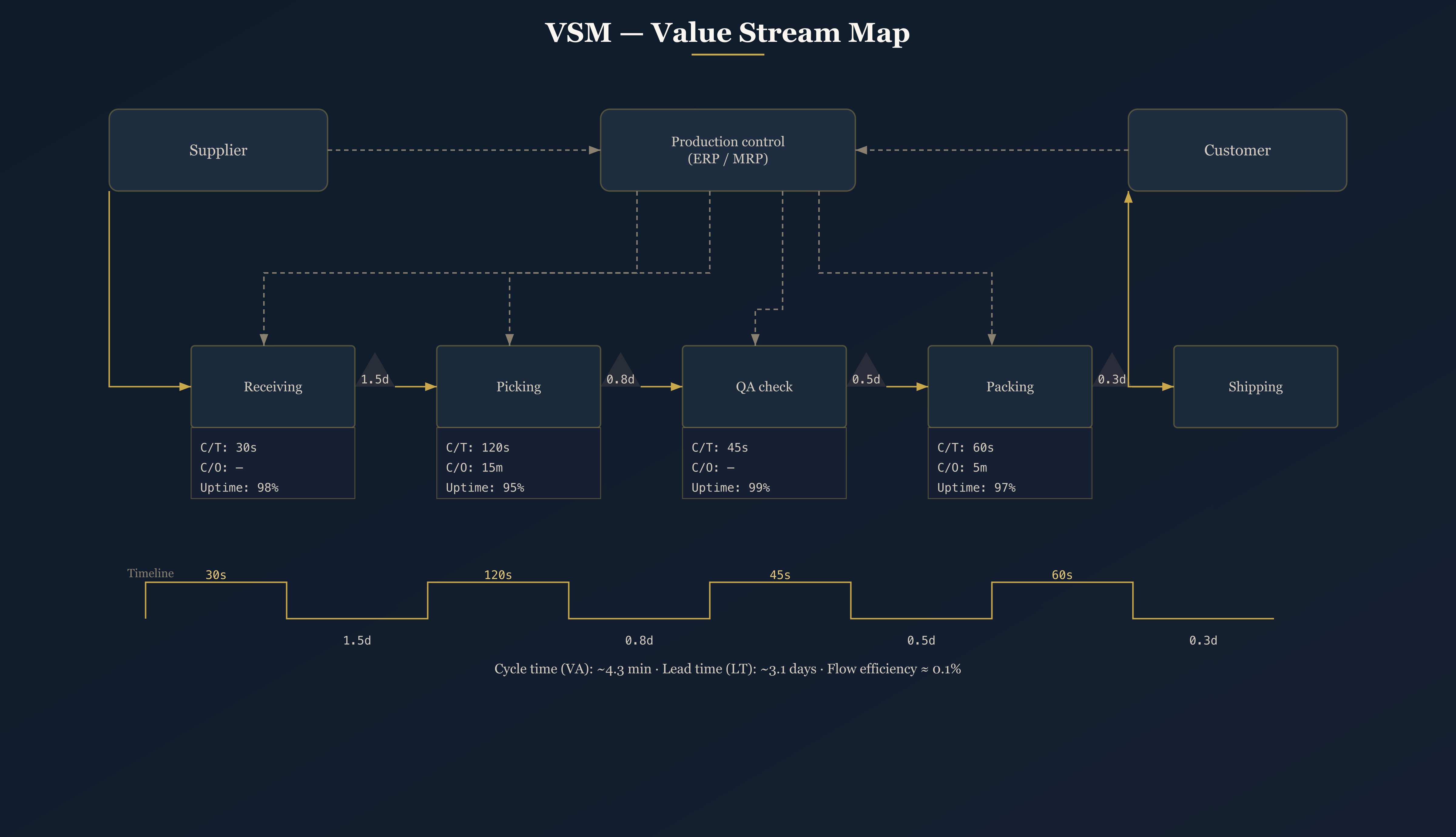
↓ Download reference poster (PDF, A2)
History
Value Stream Mapping (VSM) is a Lean tool that spread widely in the second half of the 1990s. The technique itself grew inside the Toyota Production System under the name Material and Information Flow Mapping as early as the 1970s. Its key role was turning an internal manufacturing tool into a widely available method for analyzing flows.
The basic idea
VSM visualizes the entire value stream — from the raw-material supplier to the customer receiving the product — on a single map. The key goal is to reveal waste (muda): operations that add no value from the customer’s point of view.
The map is built in two stages:
- Current State Map — the flow “as is”
- Future State Map — the target state after improvements
The seven wastes
VSM analysis focuses on Taiichi Ohno’s classic seven wastes:
- Overproduction
- Waiting
- Excess transport
- Over-processing
- Excess inventory
- Excess motion
- Defects
An eighth, added later, is the unrealized potential of employees.
Key metrics
VSM calculates:
- Lead Time — the total time a unit takes to pass through the stream
- Process Time — the time of actual processing
- Process Cycle Efficiency = Process Time / Lead Time
- Takt Time — the production rhythm that synchronizes the process with demand
A typical PCE for an untouched manufacturing process is 5–15%; for a mature Lean operation, 25–40%.
Use in services
VSM was originally created for manufacturing, but by the 2010s it had been successfully adapted for service sectors: banking, insurance, healthcare, IT operations. It is especially popular in the DevOps community, where it is applied to software delivery.
Strengths
- A unique ability to show the whole flow
- A direct focus on revealing waste
- Simpler to learn than BPMN
Limitations
- Not suited to describing branching and adaptive processes
- Has no executable semantics
- Weak tooling support (often drawn by hand or in a generic graphics editor)